

One of the most serious misconceptions in Chinese football over the years may not lie in technical shortcomings or physical deficiencies, but in a fundamental misunderstanding of what "advanced football" really means—right from the start.
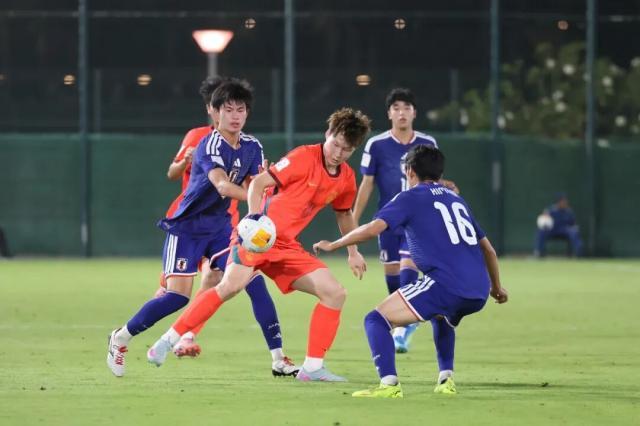
After watching consecutive U15 and U17 matches, one feeling grows increasingly strong: Chinese youth training is being led astray by the word "possession." And this deviation is beginning to systematically harm young players.
The problem starts with translation.
For the past decade or more, Chinese football media has endlessly repeated the phrase "Spanish possession football," as if simply making a few more passes and tiki-taka-ing from the back brings you closer to the heart of the modern game.
But the true foundation of Spanish football has never been "possession" in the simple sense. It is "Juego de Posición" (positional play), which originated in the Netherlands, was refined in Catalonia—especially at Barcelona—and then greatly developed.
Textbooks and coaching materials for Spanish positional play are widely available online. This term is easily confused with another—"Juego de Posesión" (possession play). They differ by just one vowel, yet represent entirely different concepts.
The core of positional play has never been "possession for possession's sake." Instead, it is about creating local numerical advantages and attacking time differentials through positional relationships, space occupation, and dynamic transitions. Possession is merely the result that strong teams achieve under the philosophy of positional play—it is a symptom, not the goal.
Thus, if you actually watch Spanish youth matches at various levels, or even the reserve teams of Real Madrid and Barcelona, you will see a reality completely different from what Chinese football imagines: plenty of long passes, quick transitions, and direct forward play are common. Sometimes there are several long clearances in a row; sometimes the goalkeeper kicks directly to the forward.
Football is, and always will be, about competition, not performance art. Yet, on China's national youth teams, we see the disastrous consequences of a dogmatic "fake possession" approach.
The U15 national team, under opponent pressure, insists on so-called "buildup from the back." After finally shifting the ball from one side to the other, the player in possession stops and waits for the opponent's second wave of pressing. Or, in the U17 team, when the opponent isn't even applying high pressure, five or six players pass the ball slowly at the back, "building up," as if keeping the ball at their feet somehow brings them closer to advanced football.
This is neither positional play nor modern football.
What's even more absurd: full-backs, without clear support or cover, mechanically execute the "play out from the feet" philosophy, attempting risky individual dribbling, only to be dispossessed directly and concede critical goals. Is this advanced football, or brainless football?
Even if we discuss things based on the faulty translation—this "buildup from the back" in possession play—its premise arises when the opponent implements high pressing. Because the opponent's pressing is meant to prevent you from organizing your attack normally and force you into hurried clearances, you need to escape the first and second lines of pressure through passing, dribbling, and coordinated movement. Once you successfully break through, you can face the opponent's mid and back lines before they have regrouped, thus gaining space and time in attack. In other words, you make the opponent pay for their high press.
To put it differently, buildup from the back is both a self-protection mechanism and a means of organizing attacks. Its true core is the "transition"—turning the opponent from active high-pressing to passive, hurried defending, and turning your team from passive, pressed defenders into active attackers.
Modern European football places increasing emphasis on transition speed. Many teams even place timers by the training pitch, requiring players to advance the ball into dangerous areas within a limited time after regaining possession. Only through such training can players develop high-speed decision-making, repeated transitional runs, and technical-tactical execution under physical duress.
In contrast, much of what passes for "buildup from the back" in Chinese youth football is just low-intensity self-consumption.
Especially in domestic matches within the same age group, some dominant strong teams rarely face genuine, high-quality full-pitch pressing. Many players have relative physical and technical advantages; their opponents lack either the ability to press continuously or a coherent pressing system—after one ineffective press, they drop back.
Thus, our pursuit of "possession" and "buildup from the back" gradually degenerates into a slow, self-indulgent exercise. When an opponent comes to press, you make a pass, execute a dribble, feel quite stylish—a hallucination of "playing very modern football."
But the real question is: can you reach the opponent's penalty area within an effective timeframe? Can you create genuine attacking threats?
That is what modern football truly cares about.
As a result, players cultivated under this Chinese football system, once they reach the international stage, immediately display a strange sense of disconnection: centre-backs afraid of pressure, defensive midfielders afraid of pressure, full-backs prone to errors when carrying the ball forward, and forwards whose first reaction after losing possession is not to counter-press, but to withdraw from the battle.
Because they have not received a complete modern football education—only a misinterpreted "possession shell."
A genuine possession system must come with high-intensity counter-pressing, collective pressing, and rapid transitions. Why do these forwards lack the habit and awareness of counter-pressing? We can even see that some cannot be bothered to actively disrupt the opponent's defensive midfielder. So much for "advanced tactics." Without forwards pressing the opponent's centre-backs and midfielders, can it still be considered advanced?
These are the consequences of learning "fake possession." We have made our best young players grow up playing a slow-paced, low-contact, low-transition, low-aggression "gentleman's football."
Over the past several years, this mistaken understanding has been long packaged as an "advanced philosophy." Anyone who questions it is labeled as "not understanding modern football." Thus, a football concept built on mistranslation and misunderstanding has smugly entered our youth training system—and even the grand narrative of "major-country football."
Is Spanish really that difficult to learn?
“体坛+”是体坛传媒集团旗下《体坛周报》及诸多体育类杂志的唯一新媒体平台。 平台汇集权威的一手体育资讯以及国内外顶尖资深体育媒体人的深度观点, 是一款移动互联网时代体育垂直领域的精品阅读应用。